
Day One:
Hello again. You join me from… You guessed it. Donington Park. This weekend is the famous Donington Historic Festival and my first time attending. I’ve just scouted the paddock and found cars five-times my age. And they’re truly a sight to behold. Naturally, I knew most of them had existed in the past, but I don’t think you quite understand the size of them until you see them in the flesh. They’re huge, burly, clumsy looking machines. But my god, they’re cool. Anyway. You join me in the pit-straight grandstand whilst the late-60s touring cars are on track. I’m not lying when I say I feel the symphony of the 1.6 litre 4 cyclinder under the bonnet of the few late-60s Guilia GTAs rattling my ribcage. Whilst that thunders by, it drowns out the softer melody of the Inline-4 motor that powers the plethora of Ford Lotus Cortina’s on the track. And those are a sight to see. Though occaisonally, my view is distracted by the plucky, audacious little Mini Cooper S with none other than Alex Brundle at the helm, trying to mix it with the big boys. I can’t quite find the words for the sensation that makes all my nerve endings tingle when the thunderous Alfa Romeo pounds by me. I believe I now understand what one James May was referring to when he described ‘the fizz’ he gets on a ‘Top Gear’ episode many moons ago.
The chequered flag has fallen on the orchestra of 1960s engineering. The soft, methodical, gentle sound of the Cortinas, married with the loud, pounding, almost clumsy bellow of the Alfas has now ceased around the circuit as they make way for, what the event organisers have dubbed, the GT3 Legends. And what a great mix of cars we have for this. Audi R8 LMS Ultras, Aston Martin V12 Vantages, Corvette GT3s, Mclaren 12C GT3s, Porsche 997s, Lamborghini Gallardo GT3s, Ferrari F430s, BMW Z4s and a sole, souped up Ford GT. These are a very different, much better noise. Not that the 60s were bad, but hearing the raging bull’s 5.2 litre v12 ring out it’s ballard whilst it frees the 600-odd Italian thoroughbred stallions to run amock. It chases a Corvette ahead, dragging an Audi R8 in tow, but unfortunately, the red flag is waved around the circuit as another of the R8s has stopped just past Starkey’s Bridge. But in only a few minutes, the culprit arrives back to the pitlane. Only not as it left. It left as a loud and proud Audi R8, but returns as a wounded dog, being dragged along by a Nissan pickup truck. But immediately after, we’re green again. That already-familiar sound of motors begins to echo across Donington Park once again, with the Gallardos seeming to be the loudest among the running cars. But all that has been blown out of the water, when a shrieking V12 Vantage comes by me in anger for the first time. I believe I’m in love. The V12 hollers and screams as it relentlessly pursues the angry beetle 997 Porsche ahead. Though, the Ferrari F430 seems to resonate with my eardrums much more than most. Now I see the Ford GT for the first time. And surprisingly, I don’t recognise it from any series past or present. But either way, boy it sounds fantastic too. Lots of pops and bangs are erupting from the exhausts of these ever charismatic, but slightly aged machines as the drivers begin to shake off the cobwebs. And this is what I wish GT racing still was. Loud. Proud. And everything else inbetween.
After this however, fans and enthusiasts alike are eagerly anticipating the upcoming Supercar Drivers/Clubs parade. Where we have been promised a fleet of Ferraris, past and present, will take to the track on a slow lap. Whilst scouting the paddock on arrival though, I made a shocking discovery. Parked up, basking in the sunlight, and waiting for it’s turn in the spotlight, surrounded by it’s Scuderia Sisters, sat one perfect-condition, one-of-599 Ferrari Daytona SP3. The multi-million dollar hypercar was casually displaying both it’s flamboyant curves, and incredible 6.5 litre V12 engine in the late morning sun. The engine it shares with it’s older sister, the Ferrari 812 Superfast. Whilst Ferrari only created 599 units of the Daytona SP3, all of them have been purchased. Though the ever-exclusive Scuderia made it rather difficult to buy one. Whilst having to be invited to purchase by Ferrari themselves is nothing new, one man reported that Ferrari said he needed a EUR 30 Million portfolio of past Ferrari purchases to even be considered for invitation. And after the chequered flag fell on the GT cars, the parade lap commenced soon after. And it was incredible to see around 20 or so Ferraris of different eras sharing the circuit together. And although a Lamborghini Revuelto and a Gordon Murray T50 managed to sneak in, it was still a fitting love letter to the more-than-iconic Italian marque. Especially that Daytona. Roof down. On a race track, V12 singing it’s finely crafted, Italian score.
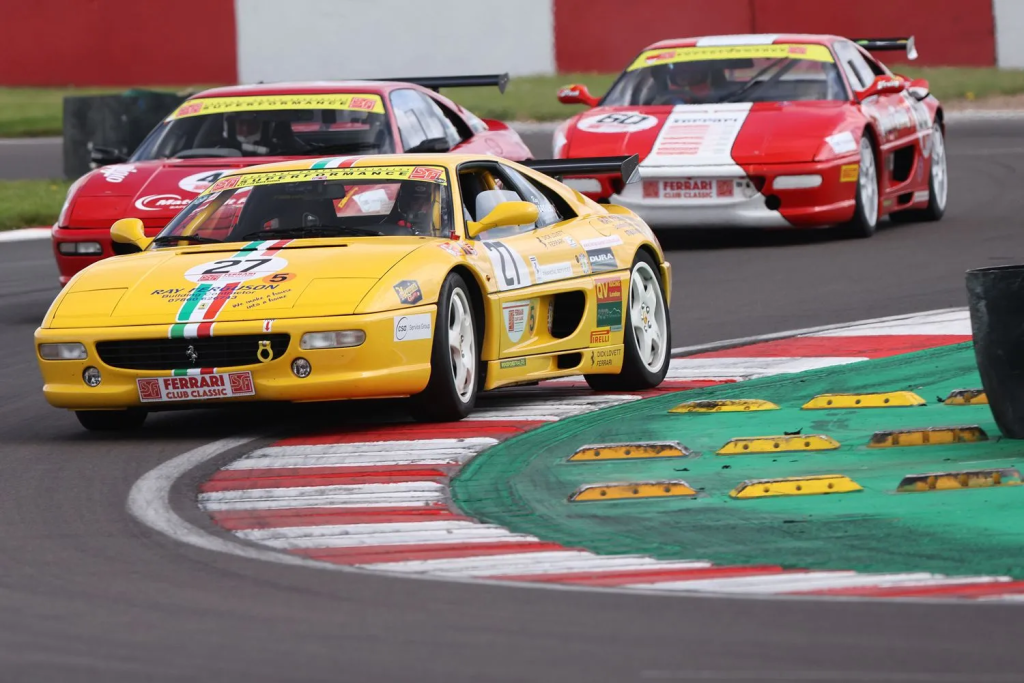
A little while later now, and I am reliably fuelled up on an extortionate and, quite frankly, lackluster double cheeseburger and fries. But on the circuit, we’re awaiting the arrival of the ‘Superformance Ferrari Club Classic’ qualifying session. It should get underway in about 5 minutes time. I can already hear the prancing horses singing as they make their way through the paddock, and it doesn’t take long for them to hit the track in anger after that. A great mix of early-to-late 90s Ferraris. 288 GTOs, 355s and a sole 355 spyder have taken to the track in a bid for pole position for tomorrow’s racing. I’m no expert, and wouldn’t claim to be one, but I believe they are all, if not most, powered by one of the Scuderia’s might V8 engines. Listening to them unleash what I can only imagine to be a few hundred of the finest Italian horses. A brand that simply needs no introduction, wearing the iconic emblem of the Prancing Horse. Unfortunately though, Donington’s party-trick keeps showing up. The symphony of Italian sports cars is occasionally rudely interrupted by the low, menacing bellow of a couple Rolls Royce (I imagine) engines bolted to the wings of some aeroplane. Presumably carrying a couple hundred holiday-making brits to Spain, Greece of the troubled Canary Islands. They don’t really like us Brits in Tenerife do they? I cannot, for the life of me, imagine why they’d want to go though. The weather’s been glorious all week, and today it’s 24 degrees and gorgeously sunny. The mind doth boggle. Anyway. I digress. Back to the on-track action. I’ve noticing that one of these Ferrari F355s is pounding around the circuit with it’s roof down! So cool! However, I’ve decided the V8s are a perfect soundtrack to go and browse what the multitude of car and owner clubs from up and down the country have brought to the circuit. Most notably of which has to be the Bond Bug. I first saw the Bond Bug when it was aired on an episode of Top Gear in the early 2010s and thought it looked absurd. But then, I saw it again on Top Gear’s unofficial, but far superior successor, Amazon’s ‘The Grand Tour’. In the episode, the trio of Clarkson, Hammond and May converted and Bond Bug into an amphibious vehicle by fitting it with an engine from a jet-ski, retractable wheels and rudder on the rear. It was this Bond Bug that went on the set a British Water speed record at the hands of Jeremy Clarkson.
I think it best I return to the on-track events now And the Pre-63 GT class have taken to the historic circuit. A fine blend of Shelby Cobras, Jaguar E-Types, solos Lotus Elise and Aston Martin DB4GT. Currently it’s a pair of Cobras thundering away from the pursuing gaggle of Jaguar E-Types. Now obviously I have no idea who’s currently leading the session, but that isn’t what I’m here for. I’m here to admire cars that came before my time, hear them sing their fossil-fuel-burning, ear-drum-rupturing, motorised melodies and watch them dust off the cobwebs and return to what they were once built to do by the boffins at Jaguar, or the ever-passionate, horsepower-obsessed Americans over the pond at Shelby American.
It was in the 60s when 24 Hours of Le Mans Winner and former Formula One driver Carroll Shelby founded his company, Shelby American, to manufacture, produce and sell his sports cars. Notable models include the fan-favourites Shelby Cobra and Shelby Daytona, which hold special places in every car enthusiast’s heart, even to this day. It was in 1966 when the decorated driver turned manufacturer went to war with Enzo Ferrari at the 24 Heures Du Mans. Shelby partnered with the American, titan of the industry, Ford Motor Company, with Henry Ford II’s seemingly bottomless pockets and built the timeless Ford GT40. It went on to beat the Ferrari 330 P3 which Old Man Ferrari brought to battle in convincing style. The ordeal was dramatised in the 2019, Oscar-award-winning movie, ‘Ford V Ferrari’ or ‘Le Mans ’66’ depending on where you’re from. A great movie by the way. Looking ahead however, with new variants and improvements, but with the core car philosophy remaining the same, the GT40 went on to win the next 3 Le Mans races in a row, and to this day, remains the only American car to win the fabled race. Tragically, after battling a heart-condition since May 1960, when he was diagnosed with angina pectoralis, a hereditary cardiac condition, which causes reduced blood flow to the heart, Shelby passed at age 89 at the Baylor University Medical Centre in Dallas Texas on May 10th, 2012. Whilst he may have faded out, his legacy has not. And will not. His engines are still thundering on and paying a sweet homage to one of the greatest, dearly missed, drivers, manufacturers and car enthusiasts that the world has known. Rest in Peace, Carroll Shelby.
However, I swear I didn’t plan this, but it’s too coincidental not to talk about. Whilst moving down the pit straight to observe from Turn 1, I spotted a finely crafted, simply stunning replica of Shelby’s Le Mans winning Ford GT40. Parked in the limelight, like Carroll himself was smiling down on it, with the iconic blue and orange colours of the Gulf Oil sponsor shining. And no more than 30 feet away, sat a perfect Ford Mustang Shelby Super Snake from the early 2010s I believe. This is only further affirming my point that Shelby was, and remains to be, one of the favourites among car enthusiasts everywhere.
Up next is the Pall Mall qualifying session. This includes a much healthier mix of Jaguar E-Types, some Lotus Elises and Elans, Shelby Cobras, Porsche 901s and MGBs. Also included in the roster is a solo bright pink Ford Mustang. As for me? I’m baking nicely surrounded by what I love most. Engine noise, freshly mowed grass and Diet Coke. Though I get the feeling I ought to think about heading home soon. I’ve got a BTCC Weekend Round-up to write, a Weekend Preview for the upcoming Miami Grand Prix to get out and all of this to type up presumably. God forbid. And with AC/DC blasting in my eardrums, barely drowning out the Mustang, I bid you farewell from the Donington Historic Festival Day One.
Day Two:
Day Two here at Donington. The paddock and the infield are much more full of car owners and drivers clubs from around the country. So much so I’ve used today to really go through and look at cars.
With such a huge roster of cars having been brought to the event this weekend, it’s hard to feel like you’ve seen everything. And with such variety in motors, you can have seen everything and nothing at all at the same time. I started in the infield as always. The sheer number of cars that arrived for the Saturday really blew me away. Starting off no less with the Morgan owners club. They brought Morgans. Believe it or not. But not just any. Morgan Three-Wheelers and Morgan Aeros. Hand-built and made out of Worcestershire, Morgan is a small company by today’s standards, only building 850 cars per year, and employing around 220 people across the company. But that doesn’t take away from the charm of a good Morgan. Even their new models. As they’re being built in 2025, they look that way. But they also resemble the classic charm that older Morgans have. Also nearby are a fleet of Lotus cars. And I really wonder how they all got here. The group is mainly made up of Lotus Espirit V8s, which were laughably reliable. But that aside, they’re all here and looking stunning the in sunshine of today. Whilst there wasn’t an early generation of Espirit I could see, they was a replica of the Roger Moore-era James Bond Lotus Espirit that had submarine capabilities. But for now, it’s looking like a celebration of British Engineering on the VE Day Anniversay Weekend. There was supposed to be a flyover too which I was really looking forward to, however it was cancelled amid growing concerns about the wind. Oh well. We live.

Up next was a Juguar ownes club, with no less that 11 Jag E-Types parked in a variety of colours. Deep metallic reds, British racing greens, deep Blues, Browns and Creams. And together, in formuation, they just looked stunning. Even with a pesky group of Alfa Romeos trying to get in the photos, the Jags certainly stole the show for some viewers. The aforementioned Alfas were parked a row back from the Jags, displaying perfectly preserved and maintained Giulias for the 60s, as well as an early ’90s Alfa Romeo Spider, which was in a slightly darker shade of red to the others, contrasting the rest well. Down the hill was a fleet of old school Lando Defenders. Series 1 through 3 Defenders lined up, adorned in either the deep green or beige British Army paint. Parked next to them was the finest little group of Mustangs I have ever laid eyes on. They were perfectly kept, well cleaned and varied enough to keep me interested. I particularly liked a bright red 1965 Mustang convertible as it was clear it was loved. The shiny red bodywork was complimented well by the deep red leather of the interior. Even showcasing embroidered galloping horses on the seats, it’s clear whoever owns this car is a real Mustang Enthusiast.
Around the other side of the treeline was a mother taking her mother for a day out at a race track. Confused? Good. I’m referring, of course, to a Lamborghini Countach, accompanied by an Aventador. With the introduction of the Revuelto into the Lamborghini family, the Aventador is no longer the new, fastest Lamborghini. Though it’s not like it’s looks have gone out of date. The angles. It’s like everything is made out of straight lines, which is particularly apparent on the Countach, and may be where the design philosphy came from. Angles. No curves. But either way, old or new, it’s clear why Lamborghinis are the real bedroom wall cars of the world. I walked straight by the GTR Owners club as I have little to no interest in the two R34 GTRs that were parked there. Hell I didn’t even take a picture of them. A small gaggle of Corvettes were next on my list. Four generations to be exact. Ranging from the 80s to the 2016 Z06. But at the top end of the infield, on the inside of Turn 1 was where it was getting real. In a space that’s usually empty and only lined with fans along the fence, today was full to bursting with classic motors. A fleet of Mustangs of various generations and power outputs was sitting pride of place in the middle, with people swarming. There was another 65 Mustang convertible alongside a 2006. Alongside those came a few Shelby Mustangs, along with a bright red RTR Mustang, which was very cool, as well as several Coyote branded cars. Though I believe this doesnt mean anything. I want to say every 5.0 V8 in a Mustang is a Coyote engine.
Behind the Mustangs were a few only Le Mans cars. No less than FIVE GT40 replicas, but also a Lola T50, adorned in a Valvoline livery which looked just exquisite. At one point, I also thought the Kray Twins had arrived, when a couple of Jaguar MkII and IIIs pulled up. In the words of Jeremy Clarkson, “that’s a properly villainous Jag.” Tucked away at the back of the growing fleet of classic and modern motors sat one of the odlest cars of the lot. First produced in 1924, the Bugatti type 35 was a rather successful Grand Prix car built by the french not long after the First World War. By the end of it’s career, the car itself had taken over 1000 races in it’s time and averaging somewhere around 14 race wins a aweek. But that wasn’t the only Bugatti present. Now that Bugatti focuses more on high speed perfomance and luxury, they have less of a need for racing. But that doesn’t mean the Divo is any less of a race car. With a sleek body design and track-focused elements, the Divo became Bugatti’s flagship, boasting an 8.0 litre quad-turbochargerd W16 motor. Along side the Divo was one of the most iconic Ferraris ever built. Brandishing it’s number plate, ‘F40 FRR’, the Ferrari F40 is one of, if not, the most well known Ferrari in the world. With it’s bold designs, iconic popup headlights and 5-spoke star-shaped rims, the F40 is loved by car enthusiasts everywhere.
Day Three:
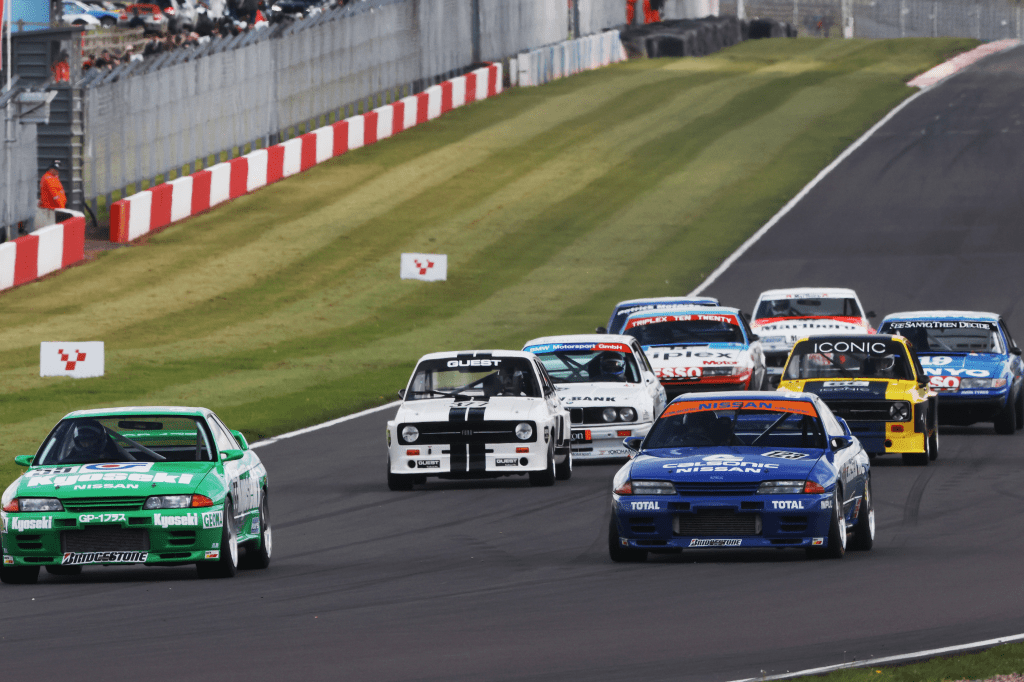
Good morning reader, and welcome back to Donington Park on this very mixed Sunday Morning. Whilst conditions are mixed, so are my feelings. But you’re here to read about cars, as appose to this author’s emotions. Currently on circuit is a demonstration run from the super-touring class. Whilst I do not know much about this class, I invested in a handy programme so I can better understand. I do recognise some of these cars as former British Touring Car legends. Vauxhall Vectras and Audi A4s make up alot of the roster, with a Ford Mondeo bringing up the rear. But a little way back, there’s a sound of what seems to be an angry horde of hornets. No. It’s real touring car royalty. Around the corner comes a 1994 Alfa Romeo 155. Equipped with a 2.5L Guiseppe Busso motor, it’s howls it’s way up the hill toward me, before diving right for the apex of McCleans. Wow. This is just become my new favourite place to sit and observe cars. I’m currently stationed on the outside of McCleans corner, which gives me a fantatic view of the cars pounding up the hill, flat out, riding the limiter heading directly at me. That is, before they’re hard on the brakes, tipping the nose in for the right hander of McCleans, and soon on the power again as they roar down the short stretch with a rather sudden incline into Coppice, then pound down Starkey’s Straight toward the Melbourne Hairpin. I’m hearing over the tannoy, however, that I’ve missed the majority of the Super Touring class demo, and the GT3 legends are lining up for their 50 minute race on this Sunday morning. And no sooner do I hear the distant screech of the claxon, do the fleet of aged GT3 machines roar back into life. Much like Friday, my ribcage is once again being rattled by the mighty V8 and V10 motors thundering by on their formation lap. But with a sizable gap to the rest of the field, the V12 Vantage 007 has just come screeching up the hill, letting it’s iconic V12 Aston Martin engine sing loud and proud, echoing among the trees. Whilst the BMW Z4s, Corvettes and GTs have a deep, low gargle to them, the V10s of the R8s and Gallardos have a slightly higher, yet still rather menacing tone to them. But nothing compares to the howl of the V12 as is flies down through the Crainer Curves toward the old hairpin. It echos across the circuit, like something akin to the Avro Vulcan takeoff howl.
After completing the free-of-charge pitwalk over the lunch break, I am filled with a sense of euphoria which can only be described by James May’s ‘fizz theory’. Rather than spending 20 minutes or so getting up close and personal with the GT3’s of the past, I nestled myself in one of the various gaps in the pitwall fencing. Doing so gave me an unrivaled and unobstructed view of the driver’s parade currently taking place. Afgter a fleet of your run-of-the-mill, standard issue supercars and nothing to write home about, around Goddard’s, a fleet of tasteful classics tour the circuit as their own. A pair of the aforementioned quintuplet of GT40s were involved. And when they thundered by, even on this slow-pace parade lap, they sounded far more alive and breathing that the flat 6 boxer engines of their leaders. A plethora of late noughties Porsches. More on that later. On the way out, in the crowd, I almost tripped over a seemingly-random Formula One car parked in a garage. Whilst it sported the ‘red-5’ of the Nigel Mansell era of William’s past, it’s not THE red five that Williams took to battle in 1991. It’s that car’s great grandma. A mint-condition 1988 Williams FW12, driven by Mansell and Riccardo Patrese. That was 1988. In 1989, Williams brought the same car back for round two, only this time equipped with a Renault V10 powerhouse as appose to the Judd V8 which was criticised by Mansell for being ‘pathetically slow in a straight line.” I here this car has been brought this weekend by the Williams Heritage crew with the intention of selling on to a willing buyer.
I packed up my things and headed to the Melbourne Loop where I set up shop again and sat down to write whilst I awaited the resumption of the racing action. On my way however, I stopped by the marquee tent which sheltered a Benetton B198 and a Williams-BMW FW22. But more on those when they come out for their glory run. Up next come the Superformance Ferrari Club Classics once again. Excellent. These days, when one goes to Ferrari and says that they would like a red one, Ferrari will offer you a B&Q-esque colour swatch and ask you which of the 20 shades of the Italian marque’s iconic colour you’d like. Though I wonder if this were the case when Ferrari was producing these F355s in the late nineties. It doesn’t seem that was as they all appear to be adorned in the ever-present Competizione Red. But the number 60 is drawing the eyes and attention of the crowd for another reason. From what I see, it’s the only car that seems to spit flames from the rear on it’s downshifts. Very cool. Sitting here is excellent as you get to see the cars come over the small crest and downhill into the heaviest braking zone on the circuit, and navigate the slowest corner of the historic circuit. Once the front tyres stop complaining and start gripping, the cars begin what looks like a painfully slow rotation. Beyond this, it’s less noticeable in these cars, but it then becomes the rear tyres turn to complain as the drivers aim to be on the loud pedal at the earliest convenience, sacrificing more mid-corner speed to get a better exit onto the short run into Goddard’s. Slow in, fast out, no? Though my eyes keep getting drawn to the bright yellow F355. I’ve always been partial to a yellow prancing horse. Some of the brand’s earliest heritage in motorsport would leave you scratching your head at the sight of the navy blue race cars Old Man Enzo took to war. Whilst it’s true that some of Ferrari’s earliest heritage would lead you to believe they had a real pedigree for a blue race car, one cannot deny, a red Ferrari is an iconic Ferrari. But the one’s sporting the nations famous ‘Tricolore’ take the cake. Perfect green stripes paired with white and red to represent the pride of the Italian people.
Up next is the HRDC Gerry Marshall series. Sicne it’s indoctrination to the MRL Historic Festival roster in Snetterton in 2022, it’s become a fan favourite of the weekend. With a one/two driver, mandatory pitstop race that lasts 45 minutes, it’s a recipe for action. The entry list has a huge mix of cars, including the infamous Chevrolet Camaro Z28, Rover’s V8-wielding SD1, Ford Capris of varying specs, Ford Fiestas and Alfa Romeos. First thing I notice is the difference in grumble between the Rover SD1 V8 and the Camaro Z28 V8. The Camaro has a much deeper, much angrier growl to it as appose to the much more reserved British V8 in the Rover. That is until the rotary-powers 1979 Mazda RX-7 comes flying by sounding like something out of a dentist’s office. Once again, I don’t have a clue who’s winning and losing. I’m just here to watch, listen and learn. The variety in vehicles is a spectacle to behold in this race. The huge, heavy Camaros having to brake early for the hairpin. The small, plucky Fiestas able to go later on the brakes. Much like the Mini Coopers in the other races today. There was also a notable number of incidents, ranging from small lockups to complete misjudgements and missing corners. Thankfully that wasn’t a real trend for the day, with all the races being completed. Included on the grid for this race in the Faberge sponsored Ford Capri is one Charles Rainford. Unknown? No. He joined the ever-competitive BTCC grid this year, as a part of the WSR team. And he’s not the only driver that takes to the track in historic events and weekends. Reigning champion Jake Hill has been known to take part in old-school races too.
There. That’s a new sound. That’s the unmistakable idle grumble of a 1990s Formula One V10 engine. At the circuit this weekend is both a Benetton B198 and a Williams FW22. But more on the Williams later. Designed by former Benetton Head of Aerodynamics turned Technical Director of Mercedes AMG Petronas Formula 1 Team, James Alison, infamous for his ‘Valterri, it’s James’ radio moments from the late 2010s and into the early 2020s. James was partnered by Technical Director for Benetton Pat Symmonds and Nick Wirth, Chief Designer and Benetton. During the 1998 season, in which the B198 was used, the car scored two successive podium finishes in Monaco and Canada as well as a pole position in Austria at the hand of Giancarlo Fisichella. In the early part of the season, the team held P3 in the Constructors Championship, though a total of 9 DNFs across 16 races meant the team dropped to fifth. Also at the circuit this weekend is the Williams FW22, which Frank Williams’ Grand Prix team brought as a challenger to the 2000 Formula One Season. After his debut season in 1999, Ralf Schumacher was partnered by another rookie who cut his teeth in the Williams before going on to win his maiden Formula One World Drivers Championship in 2009. Nine years on from debut. We are of course talking about Jenson ‘First Driver to Hit the DRS Button’ Button. The FW22 was not only the training wheels for a future world champion, but also BMW’s return to the pinnacle of motorsport as an engine supplier. Powered by a BMW V10 powerhouse, the car reached about 800 horsepower at 17,500RPMs. Schumacher scored a handful of podiums in the 2000 season, and with Button bringing it home in the points relatively consistently, Williams finished the season third in the constructors standings. But less about the history now, more about the noise. Being where I am, I have no view of the paddock or the pitlane, but I know full well both of these cars are sitting at pit-out, their engines idling, temperatures climbing and drivers ready to floor it. I sit back and twirl my pen between my fingers as I hear the cars set off. What. A. Noise. I hear the Williams shrieking down the Crainer Curvers, BMW V10 howling, echoing across the emptying infield. It was the main thing people continued to stay for, but once they’d heard it, people began filing out. The downshifts sound so clear and crisp, like a mechanical symphony. Before 6-time-Indy 500 entrant James Davidson lets the revs loose before climbing back up the gears up to McCleans. I do not exaggerate when I say I can hear the engine screaching so clearly from the other side of the circuit. It’s like I can tell exactly where he is, without being able to see the car. The Benetton is also in chase, though the driver of that car not pushing as hard as Davidson. The FW22 Flies through the Esses now, and I know it’s coming my way. I feel nerve ending light up, the hair on the back of my neck and on my forearms standing up on end. Not from the cold. but from the sheer euphoria I feel from the mechanical ballad of BMW V10 and Williams transmission. Down the gears it goes after screeching by me, one. two. three. four. five. Second gear through the Melbourne loop before launching out of the corner and down to Goddards. I hear it go through the final turn before I’m met by the Benetton. Judd V10 singing it’s own song, only alot slower than the FW22. Hearing these two cars in the flesh is an incredible experience. To hear them in videogames is cool. To hear them in real life? Extraordinary. But they only get to turn a few laps before they’re pulled into the pitlane and we’re looking ahead to what’s next.
In the second-last race of my weekend, we saw the HRDC Jack Sears Trophy. It’s a grid of up to 42 cars which would have made up what was originally titled the British Saloon Car Championship saw the introduction of production saloon car racing in the UK as a mainstream racing series. The HRDC emulates the content seen in this supremely successful series with a range of cars from 1958, to as late as 1966. As this is a huge number of cars to be bringing to one race, there’s quite a few makes and models involved. Lotus Ford Cortinas, Ford Mustangs, Ford Falcons, Austin A40 Speedwells, Alfa Romeo Giuliettas, Giulias, Mini Coopers and a sole Ford Anglia. And just from watching the first few laps, I can see why this series took off the way it did. Not only must it have been more accessible than the main motorsports of the era, but also, it was was simply amazing to watch. The huge American muscle cars of the Mustangs and Falcons being bullied and hassled in corners by the much smaller, much lighter Mini Coopers and Austins. But then the same cars then regretting harassing the burly American Muscle cars which have much more power and speed out the corner. Truly a spectacle and great fun to watch.
Up next in a 60 minute race comes the Royal Automobile Club Woodcote Trophy and Stirling Moss Trophy. A category exclusively entered by pre-1956 sports cars. And these cars are special. There are multiple Le Mans 24 Hour winners in this field, including the Jaguar C-Type and D-Type, as well as various other 1950’s sports cars. Also included in the field is an Aston Martin DB2, several renditions of the stunning Lister Knobbly, with and without the Jaguar engine, and several generations of Lotus Eleven. With their sleek, curved body panels, it’s like each of these cars has some sort of undeniable racing heritage, whether they do or not. Because each of them resembles your textbook 50s racing car.
That’s all I’ve got for today folks, as I’m feeling a little burnt out on this Historic Festival write-up. I might consider doing a part two. Thanks for reading folks!

 Heroics Into Saint Devote
Leave a comment